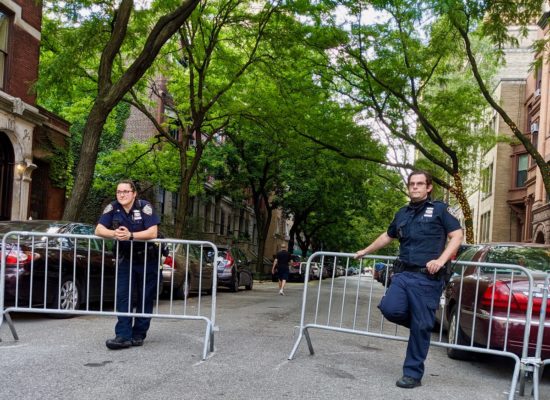
Officers on 82nd Street late last month. Photo by Joy Bergmann.
Some locals have said that the barricades have created a safety risk to pedestrians who are forced to walk in the road.
Captain Neil Zuber (pictured below), the precinct’s commanding officer, recently explained why the block is closed off in response to email questions from West Side Rag.
During the first night of the riots most Precincts and other Department facilities began expanding our Stationhouse Security. We’ve done this several times over the years depending on current threats; 9/11, obviously, as well as tragedies like the ambush murders of Officers Ramos and Liu, and any time high-profile events lead to mass demonstrations. By the second day, we knew we needed to take additional steps, and directives from 1PP (headquarters) made it mandatory. Out of necessity, each facility was told to determine its own requirements, since each is uniquely situated.
 It’s important to note, if you visit precincts around the city today, you will still see these temporary measures in place. In many instances, they also encompass surrounding blocks, and/or total traffic and pedestrian freezes. As I said, each facility is uniquely situated. Several weeks ago, ABC News did a report on this issue around the city, and received a comment from 1PP, stating in effect that the barriers were necessary and the decision would be made at Headquarters to remove the barriers when it was determined the threat had passed.
Here in the 20th Pct, we learned the hard way just how important these steps were. On the second night of the protests, 10 members of the 20th Pct were mobilized to the Barclays Center in Brooklyn, which was one of the epicenters of the unrest. These 20th Pct members were among the first to respond to the attack on the 88th Precinct, where the “10-13’s” (Officer Down/Needs Assistance) were being transmitted from inside the stationhouse. After a prolonged fight, the 88th Precinct was saved from being overrun, and the surrounding area was secured, but at a steep price. Eight of the 10 20th Precinct members at the scene, and many other officers from other commands, needed to be treated at the hospital, and several received severe injuries requiring extensive treatment. Some remained out sick for prolonged periods. This happened even though the 88th Precinct had taken initial steps to secure their stationhouse.
We learned some important lessons there. Among them:
-It was vital to be able to restrict access to the area around the precinct, not just the building itself. As the protesters approached the 88th Pct, the barriers were arrayed in a manner to allow the protesters to easily flow around them and overwhelm the Precinct.
-Our barriers are only effective if they are they are set up prior to their need, and in a manner that they can’t be easily dismantled. At the 88th Precinct, the barriers were used as weapons against the police, and tools to cause extensive damage to personal and private property.
-The barriers have to be set up in a semi-permanent way until the threat has passed. Once the need for the defensive line is necessary, it’s too late to try to set it up.
Although I keep using the 88th Precinct as the example, there are many others. During the first night of the riots, I was deployed to Manhattan South in charge of a Mobile Field Force during the initial mobilization. Our initial deployment was to help secure various precincts, and elements of my MFF were sent to at least four separate Precinct Stationhouses, and several other sites, such as City Hall.
As for the 20th Precinct itself, I made the decision to place a barrier line at each end of our block. These barriers were anchored at every available place to permanent structures, such as poles, trees, and railings, and fastened together to prevent them from being easily dismantled and used as weapons and tools to damage property. A second line was then established closer to the stationhouse in each direction, far enough away that the Molotov cocktails which were used early in the riots couldn’t be effectively thrown at our building. We took several further measures that are not nearly as obvious. For example, we had the assistance of many building superintendents and businesses on the surrounding blocks, to constantly sweep the area for loose masonry, bottles, signs, garbage cans, etc. that could be used as missiles by protesters.
I have frequently been asked if this was all necessary. My answer is always, “Yes, absolutely.” There have been literally dozens of individual times, as recently as five nights ago, officers on patrol had to race back to 82nd Street and man the barriers at either end of the block moments before large groups of protesters arrived. It would not have been possible to set up the barriers in the short amount of time available to them.
I know this is a long-winded answer. I’m trying to provide substance to show that it wasn’t a decision taken on a whim, and serves a purpose I wish we didn’t require. Among other things, it’s a drain on manpower. However, it has been extremely effective. We know we are a potential target for protesters and the people who want to cause damage. We have a responsibility to protect the lives and property of the residents on our block. Our location is one that if a large group of protesters congregates on our street, reinforcements and medical aid would not be able to get to the stationhouse or any private residence on the block.
I am happy to say we have not taken a single report of private property damage around the stationhouse during this time. However, as you know, last week a 20th Pct vehicle was vandalized and set on fire on 83rd Street. Clearly the threat has not yet passed.
"street" - Google News
August 06, 2020 at 03:48PM
https://ift.tt/3iez5NE
Police Commander Says Barricades Blocking 82nd Street Are Still Necessary; 'Clearly the Threat Has Not Yet Passed' - westsiderag.com
"street" - Google News
https://ift.tt/2Ql4mmJ
Shoes Man Tutorial
Pos News Update
Meme Update
Korean Entertainment News
Japan News Update




No comments:
Post a Comment